

Horrors in the Dark
On using fear.

One persistent piece of feedback I receive from players across groups is that they were almost always afraid to descend into the dungeon, and while there they felt gut-churning dread the entire time. Mind you, this was always complimentary: the players enjoyed the feeling of terror because it comes with the catharsis of victory (or defeat). Or so they’ve told me.
What’s interesting to me is that I don’t use any horror rulesets - I’ve never run Call of Cthulu or Delta Green and honestly I’m not well-read in the genre. What primarily informs my frame of reference is private research into real-world history and I enjoy the occasional fantasy novel or movie: high, low, and/or dark.
Campfire Tales
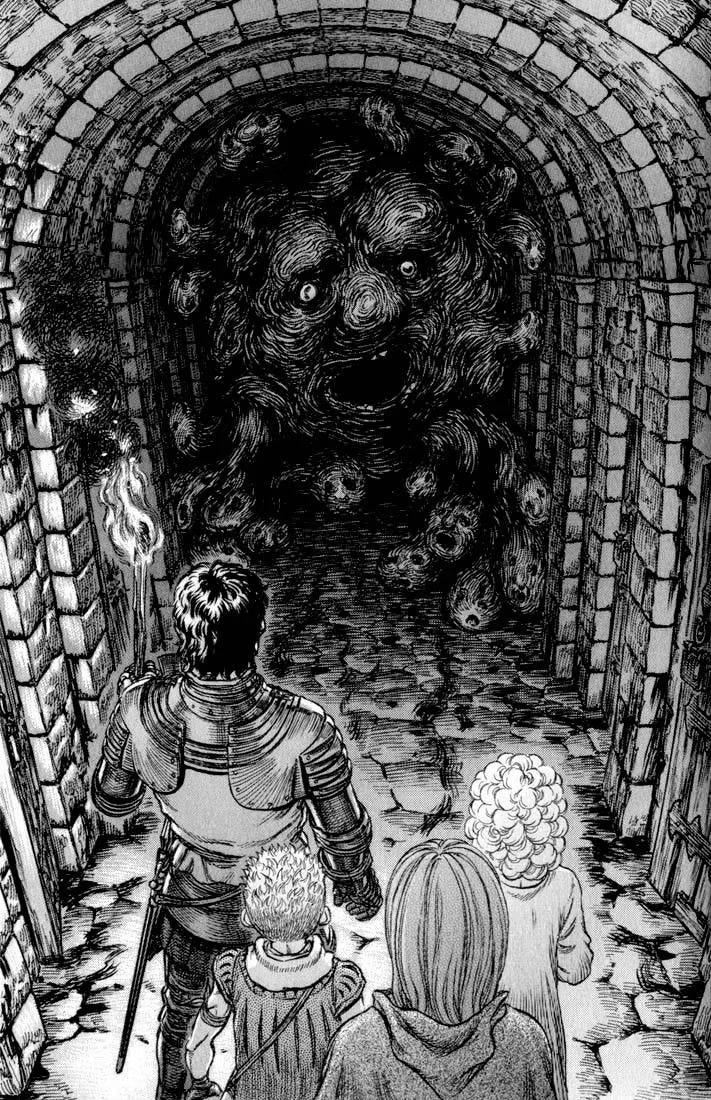
I’ve been considering what it is that I’m doing that’s working and the best I’ve been able to come up with is that I slip into a “campfire tale” mode where the details that I choose to communicate are enough to help the listener “see” what is happening in their mind but enough details are missing that they fill them in on their own.
Things shuffle or skitter in the dark, sights are difficult to confirm beyond a certain distance/light level, and/or there are disturbing implications that are never outright said.
As much as I champion strong procedure and consistent rulings for a good game, there is a certain creative quality that the Referee ought to develop over time: that is an understanding of what needs emphasis and what needs to be quickly communicated.
Scenario Dressing
I don’t like the term “scene setting” as if the referee is a director and the players are actors. What I try to keep at the center of my perspective is that the referee is the one adjudicating the scenario: they are the player’s eyes and ears. Without the referee accurately communicating information, the players won’t have an appropriate read of a situation and are not going to be able to make sound decisions.
In real life, when someone walks into a room or speaks to another person, they are taking in a million little cues and details consciously and unconsciously, all at once, that informs how they perceive what is happening and helps them come to a decision on how to react. When describing what can be seen to the players, the referee ought to consider that if they were actually there then a number of details would be known to them. It is appropriate then to be generous in the descriptions provided rather than calling for spot checks or omitting sensory data to get to a certain result. This is frustrating and will not invest the players on what is happening in front of them.
Of course, this is not a call for a machine description of events as they transpire. If players are going through a dungeon, I could simply inform them of the size and contents of each room they wander into, but dry descriptions of a chamber’s contents or how many monsters are present isn’t exactly the whole story. The players ought to know what things look like, what they smell like, what sounds are present (if any; sometimes the lack of noise is important). Describe what you must so that they capture the vibe.
Ambiguity and Purpose
Of course, some things should be mysterious. The purpose of something is rarely required, unless it’s obvious. When the players come upon a scene instigated by monsters within the dungeon, it can easily be turned into a bewildering and disturbing experience by almost never concretely confirming or denying their suspicions. The “what” is clear, but the “why” is omitted.

Consider the above example from one of the dungeons I’ve run: the players are carefully picking their way through a lost dwarven hold, searching for traps, treasure, and secret rooms. They are delighted when they find a hidden passage sealed from the decay all around them; they manage to pry the door open, but their greed is tempered somewhat by the inclusion of two dwarven skeletons. Why are they here? What were they doing? Could they indicate something hostile? Suddenly, they’re suspicious of the treasure.
I might describe the stones where they lay as stained, implied to be the aftermath of their decay or the smell of the room as being damp and musty as organic decay in a sealed room left nowhere for such scents to go. While the players deliberate and/or search the area, I’m rolling dice periodically and watching them. They ask me what I’m doing and I simply shrug, “probably nothing”. Some of these rolls will be for wandering monsters, others are nonsense to mask the wandering monster rolls.
Know Your Sources
The final piece of the puzzle is that I think a high degree of genre comfort provides the confidence to branch out. I feel solid in my understanding of what occurs in my campaign and am confident when I try new things or branch out in unexpected directions. A strong grasp of the chosen ruleset and having a creative well to draw from (whether through books, movies, games, etc.) only serves to make you more proficient at running your scenarios. Which a campaign is a series of scenarios.
I’d have to agree with the logic that says that certain games are better at producing a vibe than others, but I also think that adequate resolution systems are usually good enough if other fundamentals are solid. This theory has worked just as well for me in 5th Edition Dungeons & Dragons as it does with 1st Edition Advanced Dungeons & Dragons.
My understanding is that we have three levels of perception: what we know, what are able to handle and what we cannot explain at all. That third tier, the unknown, is that bump in the dark when it is night and you are alone at home. The brain doesn't know what's happening ... so the imagination goes wild with the worst scenarios. To hint at something like that is a great narrative tool. Works every time. It feeds right into the GM having down the fundamentals, because when you know what's moving in the dark, you extrapolate from that. It'll always be way more specific than improvising a whole encounter.
Freud's essay on The Uncanny would help. I'd attach the PDF if Substack allowed that in comments.
I miss when D&D was about killing monsters, using trickery and getting enough treasure to build a castle and claim a territory and using graph paper to plan out your castle.
"interactive improv theater" isn't even a game.
I blame that Youtube show.